Quick answer
Yes, a tote bag makes sense when you use one bag often and for a long time. A tote is also a textile product, so growing, processing and transporting its materials uses resources; if you buy several and do not use them, the point of cutting down on disposables gets weaker. How many uses it takes depends on the material and conditions, so this article does not give a specific number.
Key takeaways
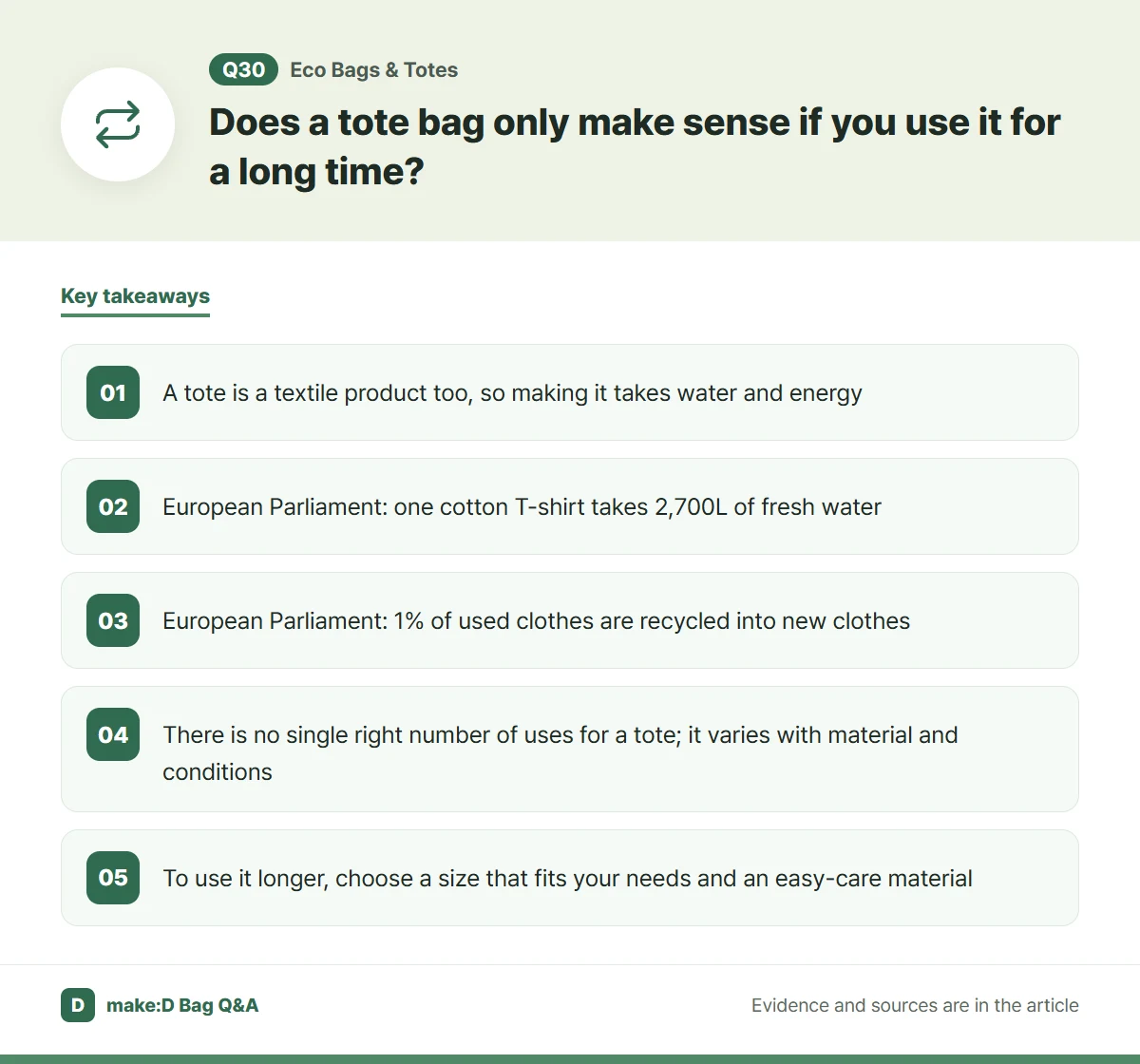
- A tote is a textile product too, so making it takes water and energy
- European Parliament: one cotton T-shirt takes 2,700L of fresh water
- European Parliament: 1% of used clothes are recycled into new clothes
- There is no single right number of uses for a tote; it varies with material and conditions
- To use it longer, choose a size that fits your needs and an easy-care material
Why does it matter to use a tote bag for a long time?
A tote bag is a textile product that uses water, energy and raw materials to make, so the longer you use one, the more uses that resource cost is spread over and the more it means.
The European Parliament says making 1 cotton T-shirt takes 2,700L of fresh water and that textile production accounts for about 20% of global clean water pollution. UN News (2019) reported that clothing and footwear production accounts for 8% of global greenhouse gas emissions. A tote is a different product from a T-shirt, but making textile products uses resources all the same.
The Ellen MacArthur Foundation report 'A New Textiles Economy' (2017) found that clothing production doubled over the previous 15 years. In a pattern of making a lot and using things briefly, the habit of using one bag for a long time is itself a way to reduce new production.
What happens when textile products are thrown away?
Most discarded textile products never go back into clothing or fabric; they are landfilled or incinerated.
According to the European Parliament, only 1% of used clothes are recycled into new clothes, and people in the EU throw away about 12kg of clothing per person each year. UN News (2019) reported that the equivalent of 1 garbage truck of textiles is landfilled or burned every second.
The European Parliament states that in 2022 textile purchases in the EU generated 355kg of carbon emissions per person. Figures like these show that how many textile products such as clothes and bags we buy is directly linked to environmental burden.
A tote is a textile product too, so unused totes piling up are likely to go the same way in the end. If you have several totes in a drawer from events or as free gifts, using the bags you already have before buying new ones is a realistic way to reduce this problem.
How do you choose a tote you will use for a long time?
To choose a tote you will use for a long time, look for a size that fits what you usually carry, sturdy stitching and handles, an easy-care material and a design you will not tire of.
The general criteria are summarized in the list below. As a make:D example, make:D's brand introduction names 'durable design that can be used for a long time' as one of its ways to reduce its environmental footprint. This is a goal the brand states.
The official store lists the Sambe Jiterian eco bag made of Andong hemp (two sizes, about 23 × 32cm and 36 × 43cm), the PMxZ Violetta mini tote made of recycled nylon and PU (35 wide × 20cm high) and the Logo Denim Mini Tote Bag made of denim and PU (W 35 × D 10 × H 20cm). Before buying, check availability and whether the size fits what you carry.
- Size: does what you usually carry fit with room to spare
- Handles and stitching: are the load-bearing parts finished sturdily
- Material: do you know how to care for it, such as washing or spot cleaning
- Design: does it go with many outfits so you will carry it often
- Bags you already own: if you have a similar bag, use it first
How do you care for a tote so it lasts?
To make a tote last, store it somewhere cool away from moisture and strong sunlight, avoid folding it in the same place again and again, and look into repair before throwing it away if it gets damaged.
The Canadian Conservation Institute (CCI) textile conservation guidelines explain that cool storage slows chemical deterioration, and that sharply folding plant-based fabrics such as flax in the same place again and again can break the fibers. Loosely woven fabrics can also shrink irreversibly in washing, so for a bag with no washing instructions it is safer to check with the seller first.
Simply emptying the bag after use and shaking out the dust reduces the buildup of dirt. Not folding a wet bag and drying it fully in the shade before storing it is the basic way to prevent mold.
The make:D product guide image states that 'products that can be repaired get free repair service within 1 year'. When a strap or stitching comes loose, asking about repair before throwing the bag away is another way to keep using it for a long time.
Frequently asked questions
How many times do you have to use a tote for it to help the environment?
A tote's environmental impact depends on its material, how it is made and how it is used, so it is hard to give a single right number. This article does not give a specific count; buying fewer new bags and using the ones you have for a long time is the advice that holds consistently.
Can I trust a tote labeled as good for the environment?
It is better to check the evidence than to judge by the label alone. The European Commission found that 53% of the environmental claims it examined were vague, misleading or unfounded. It helps to see whether specific information is given, such as the type and share of materials and any certification.
What should I do with an old tote bag?
First see whether it can be repaired; if it is hard to use as a bag, you can use it for something else, such as a spare shopping bag or a storage pouch. Finding one more use before throwing it away helps reduce textile waste.