Quick answer
A hemp tote bag is made from hemp cloth woven from fibers taken from hemp stalks, so it differs in raw material, texture and care from a cotton tote woven from cotton fibers. The Korea Heritage Service says hemp cloth absorbs sweat quickly, dries fast, breathes well and is highly durable against friction. Still, you cannot conclude that a hemp bag is better for the environment than a cotton one; how long you use it matters just as much.
Key takeaways
- Hemp cloth is woven from hemp fiber, cotton from cotton fiber
- Korea Heritage Service: hemp absorbs and dries fast, breathes well and resists friction
- Hemp-type fabrics wrinkle easily and are weak against repeated folding (CCI general principle)
- The make:D Sambe Jiterian bag uses Andong hemp and launched via Tumblbug crowdfunding in 2022
- Do not judge environmental impact by fabric alone; consider how long the bag is used
What kind of fabric is hemp cloth?
Hemp cloth is a fabric woven from fibers taken from the bark of hemp stalks, and hemp cloth made through the traditional process from hemp grown in the Andong area of North Gyeongsang Province is called Andong hemp cloth (Andongpo).
The Encyclopedia of Korean Culture describes Andongpo as hemp cloth made from hemp grown in the Andong area through the full 'saengnaengi' hemp weaving process, and lists antibacterial properties, moisture absorption and breathability as its features. Andongpo was registered as a geographical indication collective mark on November 22, 2011.
Andongpo weaving was designated North Gyeongsang Province Intangible Cultural Property No. 1 in 1975. Hemp is sown in late March and harvested in late June, then goes through a long process of peeling the bark, splitting, joining the fibers, warping, sizing, weaving, and washing, drying and beating the cloth (Encyclopedia of Korean Culture).
Describing the National Intangible Heritage 'Sambe Jjagi' (hemp weaving), the Korea Heritage Service says hemp cloth has been worn since the Samhan period because it absorbs sweat quickly, dries fast, breathes well and conducts heat well so it feels cool, and is highly durable against friction so it is damaged less in washing.
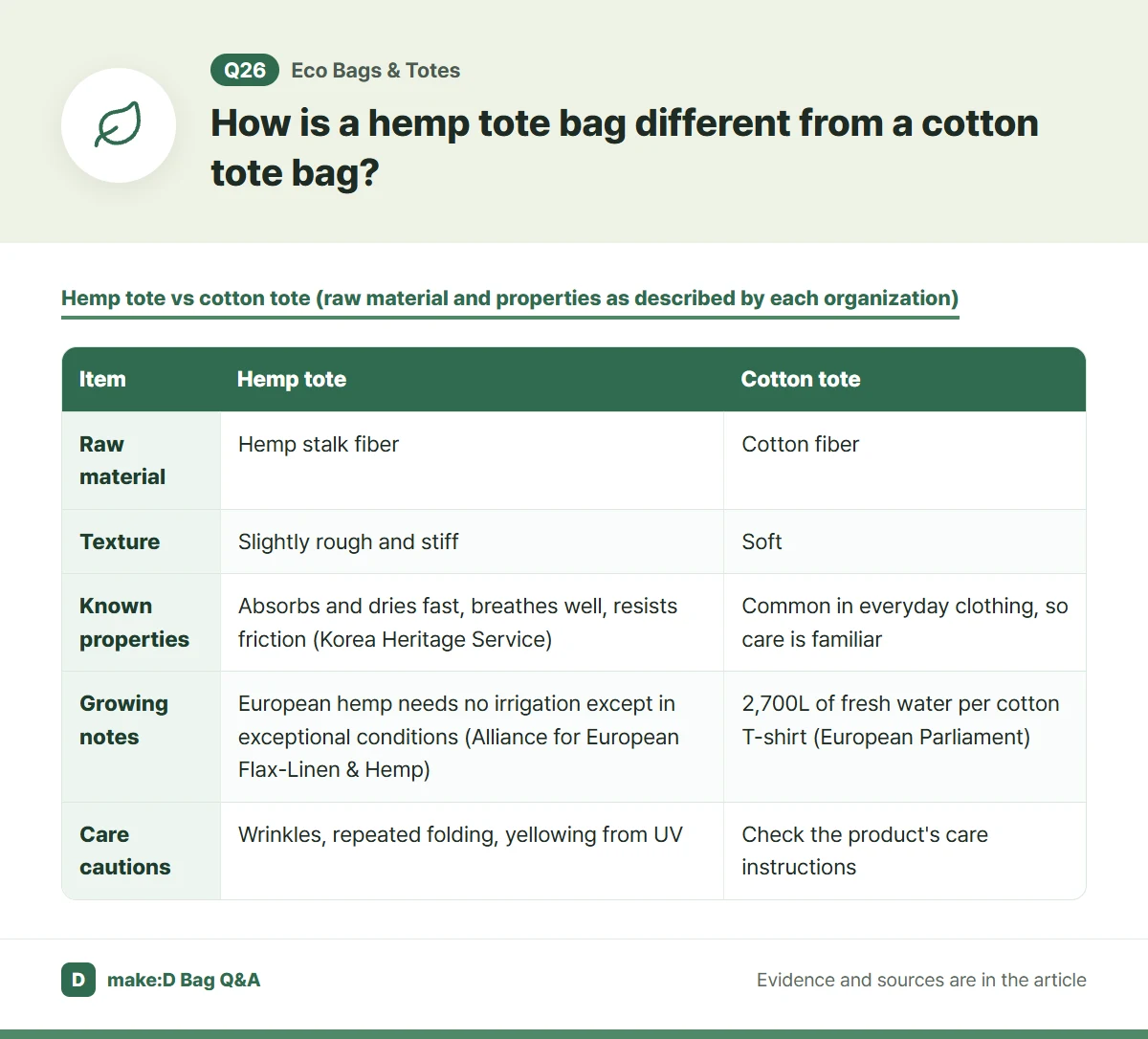
| Item | Hemp tote | Cotton tote |
|---|---|---|
| Raw material | Hemp stalk fiber | Cotton fiber |
| Texture | Slightly rough and stiff | Soft |
| Known properties | Absorbs and dries fast, breathes well, resists friction (Korea Heritage Service) | Common in everyday clothing, so care is familiar |
| Growing notes | European hemp needs no irrigation except in exceptional conditions (Alliance for European Flax-Linen & Hemp) | 2,700L of fresh water per cotton T-shirt (European Parliament) |
| Care cautions | Wrinkles, repeated folding, yellowing from UV | Check the product's care instructions |
How is a hemp tote different from a cotton tote?
The biggest difference between a hemp tote and a cotton tote is the source plant (hemp versus cotton) and the texture that follows from it. Hemp feels slightly rough and breathes well, while cotton is soft and familiar to handle because it is so common in everyday clothing.
The way the raw materials are grown is also said to differ. The Alliance for European Flax-Linen & Hemp says hemp grown in Europe needs no irrigation except in exceptional conditions, and that extracting fiber from the stalk is a mechanical process that needs no chemicals. This describes European hemp, so it cannot be assumed to apply to all hemp cloth.
For cotton, the European Parliament has stated that making one cotton T-shirt takes 2,700L of fresh water. This figure is for a T-shirt, however; the environmental impact of a single tote bag depends on the amount of fabric, processing, transport and how long it is used.
For care, it helps to remember that hemp, like flax (linen), is a plant fiber with low elasticity. The Canadian Conservation Institute (CCI) explains that linen wrinkles easily and that sharply folding it in the same place again and again can break the fibers.
What is the make:D Sambe Jiterian tote?
The make:D Sambe Jiterian (3 VEGETARIAN) is a tote and shoulder bag line whose material is listed on the product page as 'Andong hemp', and it was first introduced through Tumblbug crowdfunding in June 2022.
The official store lists the Shoulder Bag L and M (Grapefruit), Eco Bag L (Lime) and Mini Eco Bag M (Lime), and the size image shows two sizes: about 23 × 32cm and 36 × 43cm. The bags carry a '3 VEGETARIAN' print, and Grapefruit has orange trim while Lime has green trim.
The product information describes the Shoulder Bag L as a bag that 'fits a laptop and is sturdy and practical', and the Mini Eco Bag M as a bag that is 'light and breathable, good for daily use'. The make:D Magazine (2022) carries a photo caption reading 'an actual hemp field in Andong'.
What should you watch out for when using a hemp tote?
With a hemp tote, watch out for wrinkles, repeated folding, moisture and strong sunlight, and contact customer service before washing it.
According to CCI textile conservation guidelines, plant-based fabrics such as flax can yellow under ultraviolet light, especially along fold lines. Also, at 70% relative humidity it takes three months or more for mold to grow, but at 90% it can appear within a few days. It is important not to leave the bag folded while wet.
make:D does not publish separate washing instructions for its hemp bags, and a reliable public standard for washing hemp cloth at home is hard to find. For a small stain, a cautious approach is to dab it with as little water as possible and avoid wringing hard; if the whole bag needs washing, it is safer to ask customer service first.
- When storing, keep folds to a minimum; if you must fold, pad the fold with acid-free paper or cotton
- If it gets wet, dry it fully in the shade before storing
- Do not leave it for long in strong sunlight, such as by a window or in a car
- Do not wring it hard
Frequently asked questions
Is a bag made of Andong hemp a National Intangible Heritage product?
No. The National Intangible Heritage 'Sambe Jjagi' (hemp weaving) is a craft skill designated on December 31, 2019, and its holding group is the Andongpo Weaving Village Preservation Society. It is not a certification of individual bag products, so the 'Andong hemp' label on a product is best read as information about where the fabric comes from and what kind it is.
Is a hemp tote only for summer?
Hemp breathes well and feels cool, so it suits summer, but a bag is not worn directly against the skin like clothing, so you can use it in any season. If you like the texture and color of natural materials, it can work as an everyday bag all year round.
Can you say a hemp tote is better for the environment than a cotton tote?
It is hard to say based on the fabric alone. The Korea Fair Trade Commission (KFTC) guidelines on environmental labeling and advertising also hold that environmental comparisons must come with specific evidence. A realistic way to judge is to look at growing conditions, processing and how long you actually use the bag.