Quick answer
You check an 'eco-friendly bag' claim by seeing whether it states which environmental attribute has improved, and by how much, compared with other products for the same use, along with the evidence, conditions and who verified it. In Korea, the Korea Fair Trade Commission (KFTC) guidelines and a Ministry of Climate, Energy and Environment notice say blanket terms such as 'eco-friendly' must not be used alone in ways that mislead consumers.
Key takeaways
- Korea's KFTC guidelines on environmental claims took effect on September 1, 2023
- Look for specific attributes and evidence rather than blanket terms
- EU study: 53% of green claims were vague or lacked evidence
- Read goal statements separately from achieved or certified facts
- Treat a manufacturer's own figures as 'manufacturer claims'
How is an 'eco-friendly' label judged in Korea?
The Korea Fair Trade Commission (KFTC) 'Guidelines for Reviewing Environment-Related Labeling and Advertising' (in effect since September 1, 2023) treat 'eco-friendly' as describing a product whose environmental attributes are improved compared with other products for the same use. So a claim should make clear what it is compared with and what has improved.
The guidelines consider it a problem to claim 'eco-friendly' or 'non-toxic' based only on a single test result, and say designs that imply environmental benefits, such as nature images or green lettering, can also mislead. Comparisons must be specific, and claims such as 'biodegradable' must objectively prove the conditions, period and rate.
Article 6 of Korea's Ministry of Climate, Energy and Environment 'Notice on the Management of Environmental Labeling and Advertising' (amended, in effect since July 14, 2026) also says blanket terms such as 'eco-friendly', 'non-toxic' and 'pollution-free' must not be used in ways that mislead consumers. The Korea Environmental Industry and Technology Institute (KEITI) takes part in verifying claims.
How are green claims regulated outside Korea?
Through Directive 2024/825, the European Union has banned generic environmental claims that cannot prove excellent environmental performance, and the rule applies from September 27, 2026.
According to a European Commission study, 53% of green claims were vague, misleading or unfounded, and 40% had no supporting evidence. There are as many as 230 sustainability labels in use in the EU.
Having so many labels and terms also means consumers find it hard to judge by name alone. So it is worth making a habit of checking which body certified something and against what standard.
What should you check in a bag's environmental claim?
A bag's environmental claim becomes easier to judge if you check four things: scope, evidence, conditions and who verified it. Also check whether the wording refers to the whole product or only some materials.
For example, the phrase 'uses recycled materials' means different things depending on whether it covers only the outer fabric or also the lining and hardware. If there are figures, check who calculated them, whether an independent body verified them and what they are compared with.
You should also separate the goals a brand states from what it has actually achieved or had certified. A sentence such as 'aims to...' only shows a direction and does not guarantee a result.
- Scope: the whole product, or only some materials such as the outer fabric
- Evidence: whether figures or test results are given
- Conditions: for biodegradable or recyclable claims, under what conditions and over what period
- Verifier: the manufacturer's own data, or third-party certification
- Wording: a goal, or an achieved fact
How can make:D product information be read by these standards?
Most of make:D's environment-related statements are either brand goals or descriptions from material manufacturers, so the accurate way is to read each one with its source in mind.
make:D's brand introduction says it 'seeks to achieve carbon-neutral fashion in response to the climate crisis' and that every collection aims to minimize its environmental footprint. These are goal statements and do not mean a certification or an achieved result. The LWG (Leather Working Group) membership make:D announced is also an organizational membership, not certification of individual products.
The environmental figures for cactus leather come from material published by the material manufacturer, Desserto. Desserto has published the results of its own preliminary life cycle assessment (LCA), which is a preliminary estimate stated by the manufacturer. On biodegradation, Desserto itself adds the condition 'partial under specific conditions (anaerobic, high temperature)'. The recycled nylon mini tote does not state whose yarn it uses, so if you want to know, you can ask the official store's customer center.
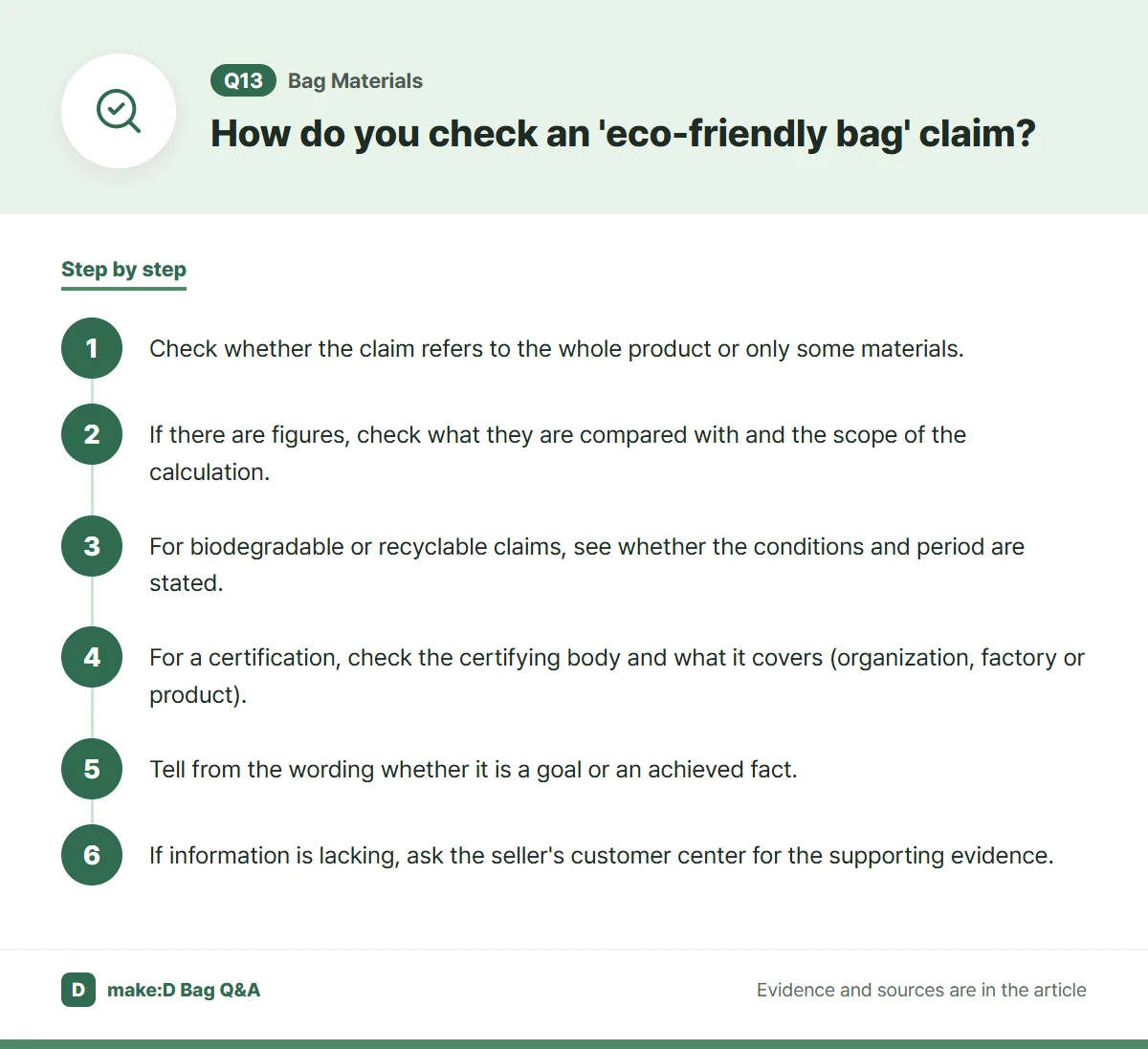
Step by step
- Check whether the claim refers to the whole product or only some materials.
- If there are figures, check what they are compared with and the scope of the calculation.
- For biodegradable or recyclable claims, see whether the conditions and period are stated.
- For a certification, check the certifying body and what it covers (organization, factory or product).
- Tell from the wording whether it is a goal or an achieved fact.
- If information is lacking, ask the seller's customer center for the supporting evidence.
Frequently asked questions
If something is called vegan leather, can you assume it is eco-friendly?
Vegan leather has no official definition and is a broad term for leather alternatives made without animal-derived materials. It includes both bio-based materials and synthetics such as PU, so you need to look at the raw material share, durability, lifespan and disposal together.
Do green packaging or leaf images count as environmental claims?
The KFTC guidelines say nature images or green lettering can give a misleading impression of environmental benefits. Rather than judging by images or colors alone, check the specific wording and evidence.
Does that mean figures published by manufacturers cannot be trusted?
It does not mean manufacturer figures are wrong, but their weight depends on whether they were independently verified. Checking whether the calculation basis and scope are published, and whether there is third-party verification or academic research, helps you judge.