Quick answer
Not all vegan leather is eco-friendly. Vegan leather has no official definition; it broadly refers to leather alternatives made without animal-derived materials and includes both bio-based materials and synthetic materials such as PU. So to judge environmental impact, you need to check the share of raw materials, durability, useful life and disposal together.
Key takeaways
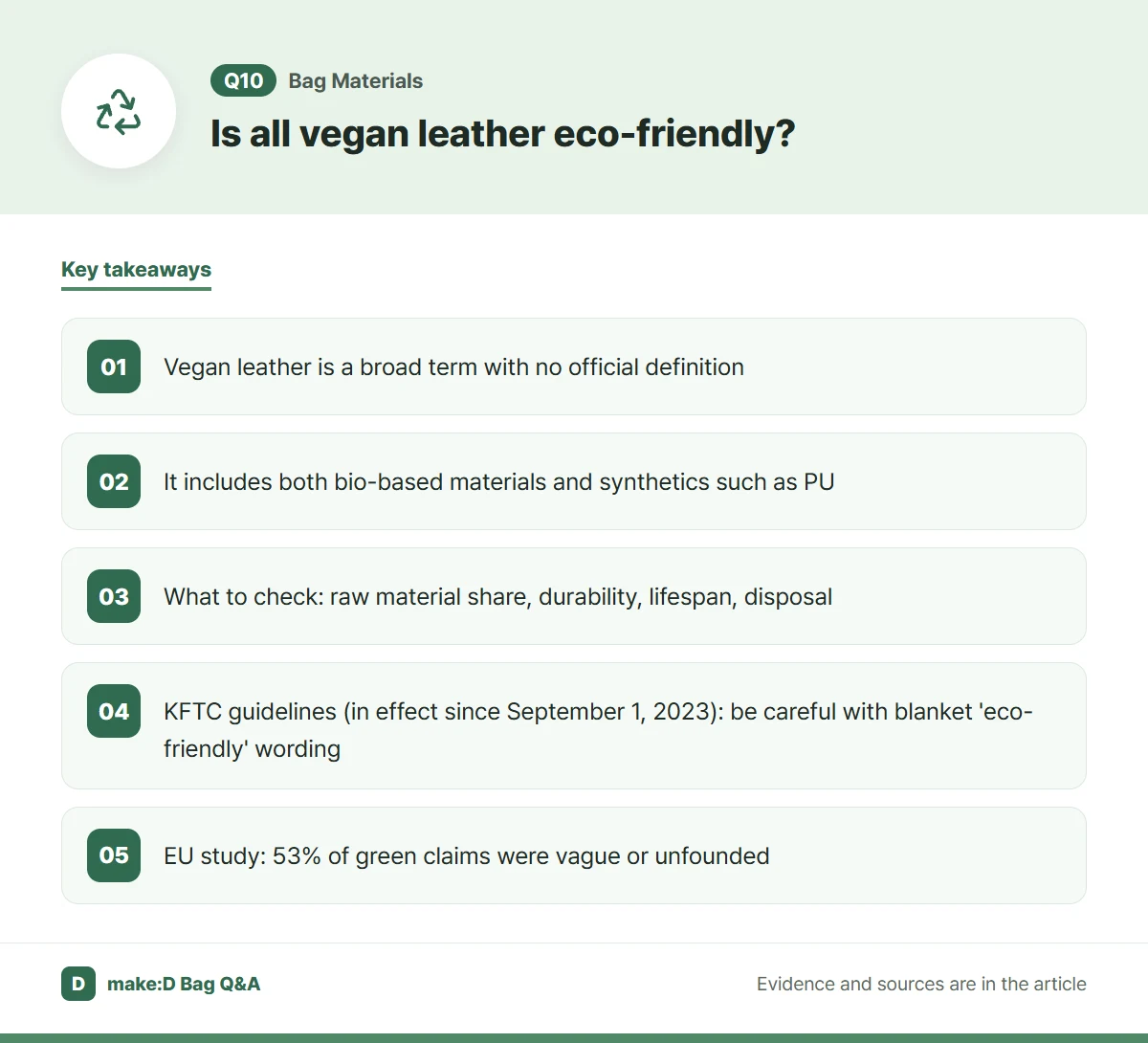
- Vegan leather is a broad term with no official definition
- It includes both bio-based materials and synthetics such as PU
- What to check: raw material share, durability, lifespan, disposal
- KFTC guidelines (in effect since September 1, 2023): be careful with blanket 'eco-friendly' wording
- EU study: 53% of green claims were vague or unfounded
What is vegan leather?
Vegan leather is a broad term for leather alternatives made without animal-derived materials, and there is no official definition set by law or standards.
Vegan leather includes both bio-based materials mixed with plant inputs such as cactus and synthetic materials such as PU (polyurethane). 'Vegan' means no animals went into the raw materials; it does not also mean the environmental impact is small.
For example, the cactus leather make:D uses is listed in the product material field as 'cactus leather (PU)'. It is made by mixing cactus material with PU and dyes and coating it onto a fabric, so it contains both plant material and synthetic components.
Why isn't vegan leather automatically eco-friendly?
Vegan leather can also contain synthetic components, and biodegradability, recyclability and product lifespan vary by material, so the fact that something is 'vegan' is not enough to judge its environmental impact.
According to Desserto, even its most advanced grade of cactus leather is '90% bio-based', and its biodegradation is 'partial under specific conditions (anaerobic, high temperature)'. Even materials known as plant-based can only be understood accurately when you look at conditions and proportions like these.
Durability is also an important factor. The Meyer et al. (2021, Coatings) study concluded that none of 9 leather alternatives showed the full overall performance of animal leather. If something wears out quickly and has to be replaced often, more new products are needed.
What rules apply to green claims?
Both Korea and the European Union regulate the use of blanket terms such as 'eco-friendly' without evidence.
The Korea Fair Trade Commission (KFTC) 'Guidelines for Reviewing Environment-Related Labeling and Advertising' (in effect since September 1, 2023) treat 'eco-friendly' as describing a product whose environmental attributes are improved compared with other products for the same use, and consider it a problem to claim 'eco-friendly, non-toxic' based on a single test result. A 'biodegradable' claim must objectively prove the conditions, period and rate. Article 6 of Korea's Ministry of Climate, Energy and Environment 'Notice on the Management of Environmental Labeling and Advertising' (amended, in effect since July 14, 2026) also says blanket terms such as 'eco-friendly', 'non-toxic' and 'pollution-free' must not be used in ways that mislead consumers.
The European Commission has said that 53% of green claims were vague, misleading or unfounded, and 40% had no supporting evidence. EU Directive 2024/825 bans generic environmental claims unless excellent environmental performance can be proven, and it applies from September 27, 2026.
What should you check when choosing a vegan leather product?
When choosing a vegan leather product, it is a good idea to check four things: raw material composition, what a certification covers, durability and disposal.
In its brand introduction, make:D says every collection aims to minimize its environmental footprint, and lists 'durable designs that can be used for a long time' as a method alongside material choice. This is a goal stated by the brand, and shoppers can check individual products themselves with the items below.
- Raw material composition: check the bio-based share and any synthetic components (PU, etc.)
- Certification scope: tell apart vegan certification, bio-based certification and recycled fabric certification
- Durability: check whether repair service is available and for how long
- Disposal: for biodegradability or recyclability claims, check the conditions and scope
Frequently asked questions
Does cactus leather have a smaller environmental burden than PU synthetic leather?
According to Desserto's own preliminary LCA (per 1 m², cradle to gate), greenhouse gases are 1.39 kgCO2eq for cactus leather, 4.81 kgCO2eq for PU and 27.30 kgCO2eq for animal leather. However, this is a preliminary estimate published by the manufacturer and does not include the use and disposal stages.
If a product is vegan certified, is it eco-friendly?
Vegan certification is about whether animal-derived materials are used, so it does not directly show environmental performance. Desserto also says that, separately from its vegan certification, it holds GRS certification for its recycled backing fabric and the USDA BioPreferred bio-based product label.
Why does using something for a long time matter?
According to European Parliament material, 1% of used clothes are recycled into new clothes, and people in the EU throw away about 12 kg of clothing per person each year. Whatever the material, using one product for a long time and repairing it reduces the amount thrown away.