Quick answer
The usual way to deal with a bag that got wet in the rain is to take out the contents right away, press (not rub) the water out with a soft, dry cloth, stuff the bag to hold its shape and let it air-dry in the shade. Avoid direct heat such as a hair dryer or heater, which can deform the material. The make:D official store has no product-specific care guide, so if marks or deformation remain after drying, we recommend contacting customer service.
Key takeaways
- Take out the contents and press with a dry cloth to absorb the water
- Avoid direct heat such as hair dryers and heaters
- Stuff it to hold its shape and air-dry it in the shade
- Do not put it in a closed space before it is fully dry
- Mold grows easily on leather above 65% relative humidity (CCI)
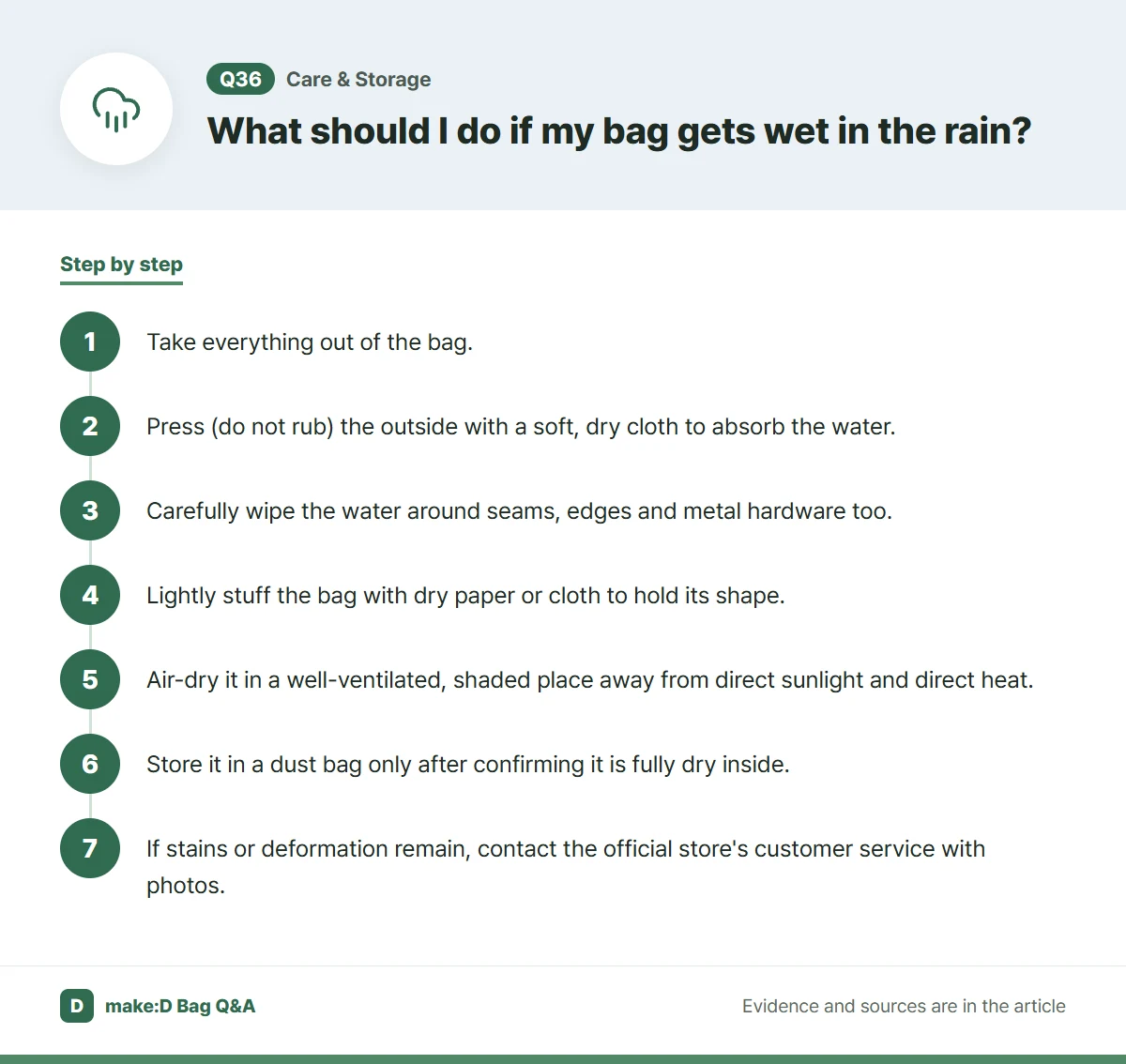
What should I do first when my bag gets wet in the rain?
The usual first step is to take everything out of the bag and press a soft, dry cloth or towel against the outside to absorb the water.
Rubbing while drying can leave marks on the leather surface or coating or raise the threads of fabric, so it is better to place a cloth on it and press lightly to soak up the water. Water tends to collect around seams, edges (painted edges) and metal hardware, so wipe those too.
The Canadian Conservation Institute (CCI) explains that most leather is damaged by direct contact with water, and that vegetable-tanned leather can shrink or stiffen when wet. The shorter the time it stays wet, the smaller the effect, so it is best to tend to it as soon as you get home.
| Material | make:D example | What to watch for |
|---|---|---|
| Cowhide | ggumini cowhide mini bag (genuine cowhide, suede lining) | May shrink or stiffen when wet; watch for stains on the suede lining |
| Cactus leather (PU-coated fabric) | Cactus leather micro belt bag and others | Wipe the surface with a dry cloth and check for water seeping into seams and edges |
| Tweed | Tweed Mini Bag Black (cactus leather, tweed fabric) | Rubbing raises the threads; do not leave it wet |
| Hemp | Sambe Jiterian (Andong hemp) | Do not wring; dry fully to prevent mold |
How should I dry a wet bag?
The usual method is to stuff a wet bag lightly to hold its shape and let it air-dry in a well-ventilated, shaded place out of direct sunlight.
Use dry paper or cloth for stuffing, and replace it when it gets damp. CCI explains that stuffing keeps the shape but overstuffing stretches leather, so add only enough to keep the original shape. If the strap and chain can be detached, it is better to dry them separately.
Avoid places where heat hits directly, such as in front of a hair dryer, heater or fan heater. CCI explains that lights that give off heat dry leather out locally, and heat applied to dry it quickly can stiffen leather or deform coated fabric.
Wipe metal hardware and chains separately with a dry cloth so no moisture is left. If the lining is wet, leave the opening open while drying so air reaches the inside; check now and then that the shape is not collapsing, and swap damp stuffing paper for dry paper.
Does what to watch for differ by material?
Each material reacts to water differently, so watch for shrinking and stains with cowhide, water seeping in through seams and edges with coated fabrics such as cactus leather, and shrinking and mold with fabrics such as tweed and hemp.
make:D products use many materials, including cowhide, cactus leather (PU), tweed fabric, Andong hemp, recycled nylon and denim. The official store gives no water-resistance ratings or care methods by material, so use the table below as general principles.
One customer review mentions that 'there was a notice that the leather can deform on rainy days or very cold days'. This is based on personal experience, but on very rainy days a safe precaution is to put the bag under a cover or inside a larger bag so it is not directly rained on.
What should I check once it is dry?
Once it is dry, check for stains, deformation and the condition of the metal hardware, and put it in a dust bag only after confirming it is fully dry inside as well.
Even if the outside is dry, moisture can remain in the lining or inside the seams. CCI explains that mold grows readily on leather above 65% relative humidity and that on fabrics mold can appear within a few days at 90% relative humidity. It is important not to put a bag that is not fully dry into a closed closet or plastic bag. If the inside still feels cool and damp when you press it, it is better to dry it for about another day.
If you see water marks, deformation or stitching that has come apart, take photos and contact the official store's customer service. The official store's product guide image states that 'products that can be repaired get free repair service within 1 year'; this is the guidance as of the time of writing (November 2026) and may change.
Step by step
- Take everything out of the bag.
- Press (do not rub) the outside with a soft, dry cloth to absorb the water.
- Carefully wipe the water around seams, edges and metal hardware too.
- Lightly stuff the bag with dry paper or cloth to hold its shape.
- Air-dry it in a well-ventilated, shaded place away from direct sunlight and direct heat.
- Store it in a dust bag only after confirming it is fully dry inside.
- If stains or deformation remain, contact the official store's customer service with photos.
Frequently asked questions
Is cactus leather waterproof?
The make:D official store says nothing about the water resistance of its cactus leather products. Cactus leather is a coated fabric made by mixing in PU and applying it to a base fabric, so drops on the surface can be wiped off, but water can seep in through seams and edges, so it is best not to use it like a waterproof bag.
Can I use the cool setting on a hair dryer to dry it faster?
There is no official guidance on how cool air affects the material. In general, avoiding direct heat and air-drying in the shade is recommended, so it is safest to stick to air-drying even if it takes time. Even when you need it dry quickly, it is enough to keep swapping in dry towels to absorb the water and leave the bag in a well-ventilated, shaded spot indoors.
My leather stiffened after getting rained on. Can I apply oil?
There is no official guidance on whether leather care products suit make:D products, and CCI explains that alkaline products such as saddle soap are harmful to leather. Before applying any product on your own, we recommend telling customer service about its condition and asking for advice.