Quick answer
The basic care for a cowhide bag is to keep it somewhere that is not humid (relative humidity 65% or lower), avoid water, heat and ultraviolet light, and handle it with clean hands. The Canadian Conservation Institute (CCI) explains that mold grows readily on leather when relative humidity is above 65%, and that most leather is damaged by direct contact with water. The make:D official store has no product-specific care guide, so read this article as general principles and ask customer service about details.

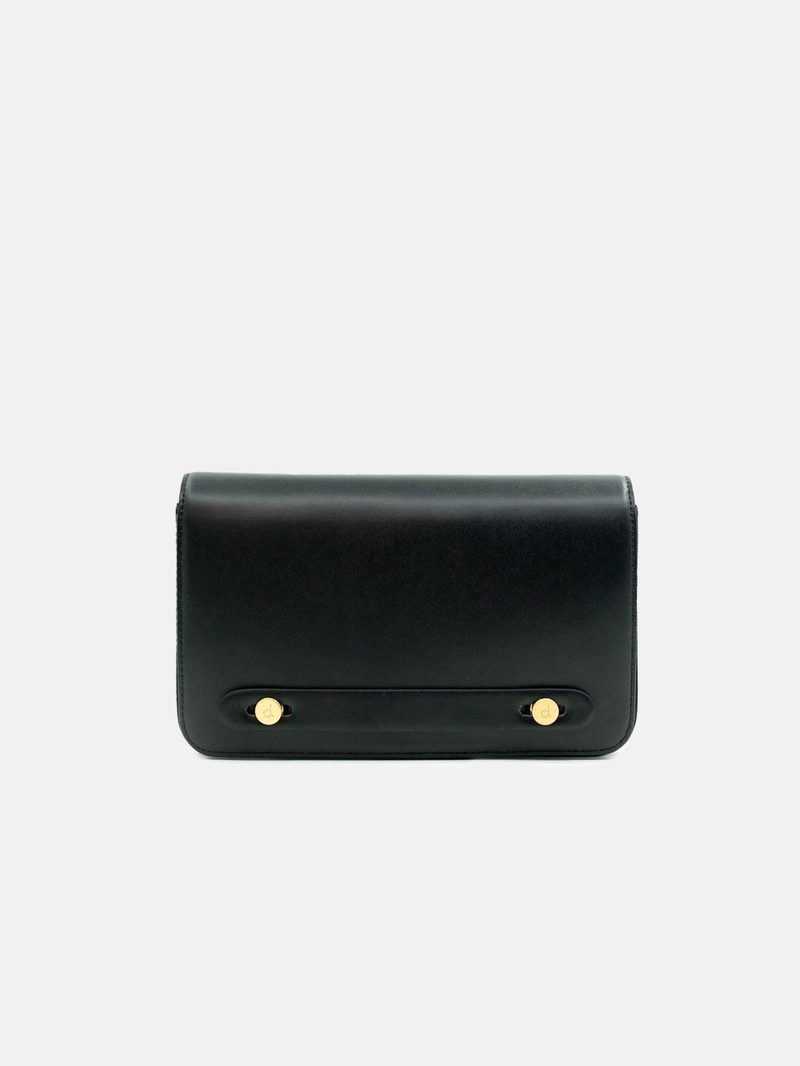
Images: make:D official store product pages. Check availability and prices on the official store.
Key takeaways
- Mold grows easily on leather above 65% relative humidity (CCI)
- Most leather can be damaged by direct contact with water
- Alkaline products such as saddle soap are harmful to leather (CCI)
- Lowering room temperature by 5°C roughly halves the rate of chemical deterioration
- The make:D official store has no product-specific care guide
What leather are make:D cowhide bags made of?
According to the official store's product information, the ggumini cowhide mini bag is listed as genuine cowhide outside with a suede lining, the Cowhide Mini Bag 2nd Black as cowhide (recycled leather), and the cowhide version of the gold chain clutch as Italian cowhide.
The ggumini cowhide mini bag is presented as a make:D signature line measuring 22cm wide × 15.5cm high × 5cm deep that can be carried 3 ways: by hand, on the shoulder or crossbody. The outside is cowhide and the inside is suede, so the care approach differs slightly between the outer surface and the inside.
The product pages say nothing about the tanning method or finishing. So the content below is not an official care method for a specific product but general principles taken from the Canadian Conservation Institute (CCI) leather conservation guidelines.
What storage conditions suit a leather bag?
The general principle is to keep a leather bag somewhere cool that is neither too humid nor too dry, and CCI explains that mold grows readily above 65% relative humidity.
According to CCI, leather needs more careful handling in very dry conditions below 30% relative humidity. It is best to avoid both damp places, such as a closet or shoe cabinet in the rainy season, and dry places, such as right next to a heater in winter.
CCI also explains that lowering room temperature by 5°C roughly halves the rate of chemical deterioration. That is why, even within the same home, a cool storage space is better for long-term storage than a sunny windowsill.
- Avoid closed spaces where moisture builds up
- Do not keep it near heaters or lights that give off heat
- Avoid windowsills in direct sunlight
- Use a dust cover (dust bag)
How do water, light and hand grime affect leather?
CCI explains that most leather is damaged by direct contact with water, that ultraviolet light and heat discolor leather or dry it out locally, and that oils and dirt from hands transfer to the leather.
CCI explains that vegetable-tanned leather in particular can shrink or stiffen when it gets wet. The tanning method of make:D cowhide products is not stated, so keeping any leather from getting wet is a safe standard.
Keeping colored materials out of light is also a general CCI principle. Museums handle leather with gloves, but in daily life you can apply this by washing your hands before handling the bag and not gripping the handle for long right after applying hand cream.
With use, leather can change in color and sheen, starting with frequently touched areas such as the handle and corners. Not every such change is a defect, but if it suddenly cracks or the stitching comes apart, refer to the official store's product guide image, which states that 'products that can be repaired get free repair service within 1 year', and contact DEKAM Co., Ltd. customer service.
Can I use leather cleaner or soap?
CCI explains that alkaline products such as saddle soap are harmful to leather, so it is safer not to use cleaners whose ingredients you do not know and to ask customer service first.
The make:D official store gives no guidance on cleaners or conditioners suited to its cowhide products. Some leather care products can leave stains or discoloration, so if you want to use one, the usual method is to test it first in an inconspicuous spot.
The suede lining behaves differently from the outer leather and marks easily if water or cleaner touches it. If makeup or a drink gets on the inside, do not rub; press with a dry cloth to absorb it and then consult customer service.
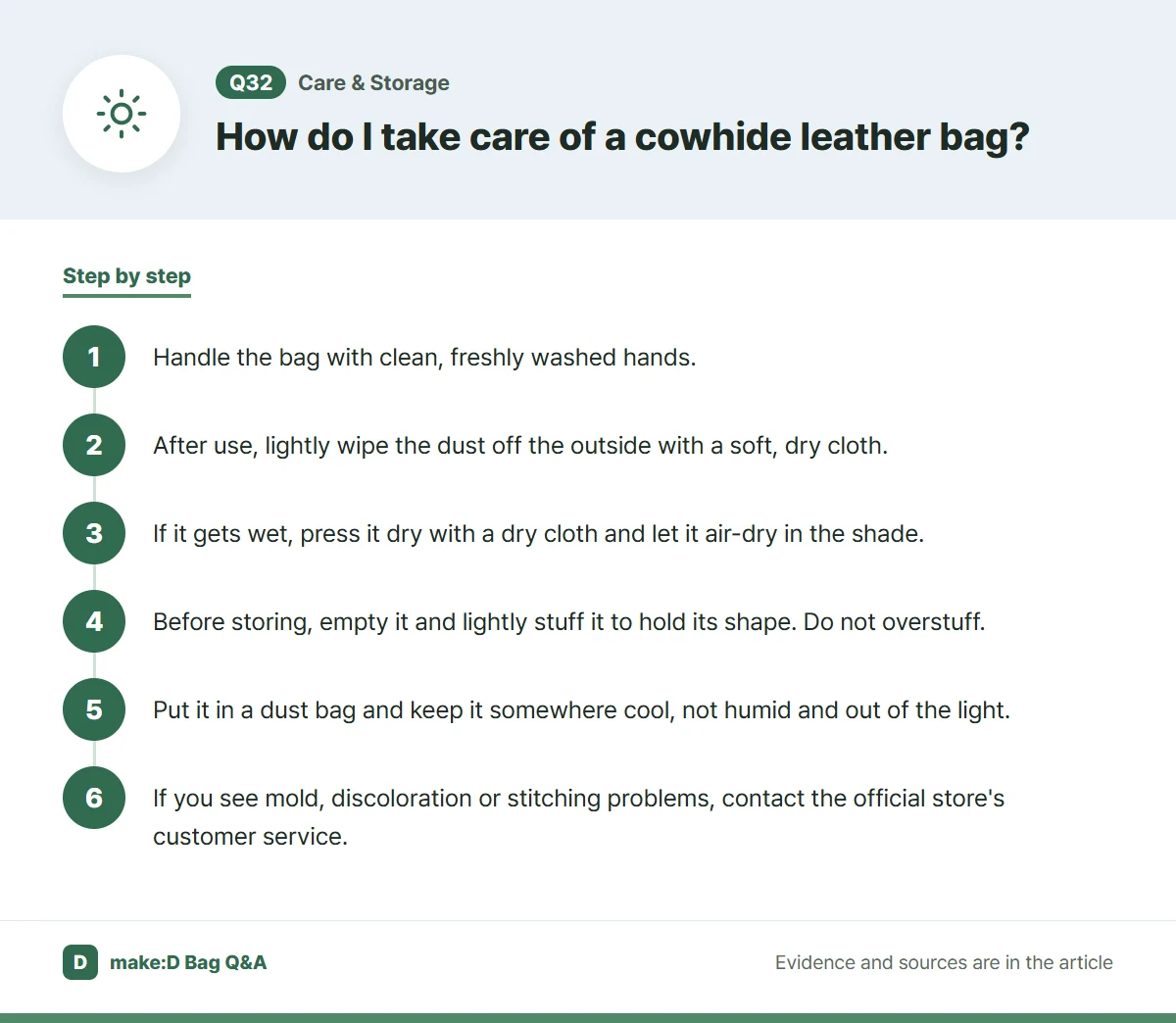
Step by step
- Handle the bag with clean, freshly washed hands.
- After use, lightly wipe the dust off the outside with a soft, dry cloth.
- If it gets wet, press it dry with a dry cloth and let it air-dry in the shade.
- Before storing, empty it and lightly stuff it to hold its shape. Do not overstuff.
- Put it in a dust bag and keep it somewhere cool, not humid and out of the light.
- If you see mold, discoloration or stitching problems, contact the official store's customer service.
Frequently asked questions
Should recycled leather be cared for like regular cowhide?
On the official store, the Cowhide Mini Bag 2nd Black lists its material as 'cowhide (recycled leather)', but there is no explanation of how it is processed. The general principles of avoiding water, heat and light and storing it dry still apply, and it is best to check with customer service before using any care products.
What should I do if mold appears on my leather bag?
Mold forms easily in humid conditions, so first move the bag somewhere dry and ventilated. Using cleaners on your own can leave stains, so we recommend photographing the bag's condition and contacting customer service. If you take it to a dry cleaner in Korea, note that Korea's Consumer Dispute Settlement Standards set the useful life of a leather bag at 3 years for calculating compensation.
Is cowhide harder to care for than cactus leather?
The two materials behave differently, so it is hard to say which is easier. Cowhide needs care around water, humidity and alkaline cleaners, while cactus leather care centers on keeping the PU-coated surface dry and clean. For both materials, the general principle is to avoid direct sunlight and direct heat.