Quick answer
To store a bag for a long time, the basics are to empty it, stuff it lightly to hold its shape, put it in a dust bag and keep it somewhere cool, out of the light and not humid. The Canadian Conservation Institute (CCI) recommends using a dust cover, blocking ultraviolet light and not overstuffing, and explains that lowering room temperature by 5°C roughly halves the rate of chemical deterioration. The make:D official store has no product-specific storage guide, so treat this article as general principles.

Images: make:D official store product pages. Check availability and prices on the official store.
Key takeaways
- Empty the bag before storing and make sure it is fully dry
- Stuff only enough to keep the shape; do not overstuff (CCI)
- Use a dust bag to keep out dust and light
- Mold grows easily on leather above 65% relative humidity (CCI)
- Lowering the temperature by 5°C roughly halves the rate of chemical deterioration (CCI)
What should I do before putting a bag into storage?
Before storing, first empty everything out of the bag, wipe the dust off the outside with a dry cloth and make sure it is fully dry inside and out.
Items such as receipts, makeup or pens left inside can leave marks from being pressed for a long time, or leak and cause stains. CCI explains that oils and dirt from hands also transfer to materials, so tidy it with clean hands.
If it has ever been wet from rain or sweat, dry it thoroughly, including the lining and seams, before storing. Putting it in a closed space while not fully dry makes mold more likely.
For a bag with a detachable strap, coiling the strap loosely rather than tightly reduces crease marks. For a metal chain, one option is to wrap it in a soft cloth and store it with the bag so it does not leave pressure marks or scratches on the bag's surface.
How should I stuff the inside of a bag?
The general principle is to stuff the bag with paper or soft cloth only enough to keep its original shape, without putting in so much that the material stretches.
CCI explains that stuffing keeps the shape but overstuffing stretches leather. A small mini bag such as the ggumini cowhide mini bag (22cm wide × 15.5cm high × 5cm deep) holds its shape with very little, so add a bit at a time and check.
Fabric bags such as hemp are often stored folded, but CCI explains that sharply folding plant fabrics such as linen in the same place again and again can break the fibers. Keep folds to a minimum and pad any fold with acid-free paper or cotton.
Where is the best place to store a bag?
The general principle is to store a bag somewhere out of direct sunlight, cool, and neither humid nor overly dry.
According to CCI, mold grows readily on leather above 65% relative humidity, and leather needs more careful handling in very dry conditions below 30%. On fabrics, at 70% relative humidity it takes three months or more for mold to grow, but at 90% it can appear within a few days.
Light matters too. CCI says to avoid ultraviolet light and protect colored materials from light, adding that linen can yellow under ultraviolet light. Cool storage also slows chemical deterioration, so a shaded cabinet is better than a sunny windowsill or a spot near a heater.
Taking the bag out once or twice when the seasons change to air it and check its condition helps you catch mold or discoloration early. If you see a problem, take photos and contact the official store's customer service.
- A place out of direct sunlight
- A place away from heaters and lights that give off heat
- A ventilated place where moisture does not build up
- A place where it is not crushed under other bags
Why use a dust bag?
A dust bag keeps out dust and light and reduces rubbing and contact with other items, so it is the basic cover to use when storing a bag for a long time.
CCI also recommends dust covers for storing leather. According to customer reviews, make:D products have arrived in a dust bag, and the brand magazine (2022) says the ggumini series dust bags are made of organic cotton.
Using a separate dust bag for each bag also helps reduce color transfer from other materials onto coated surfaces such as patent leather or onto light-colored bags. For bags with chains or metal hardware, arrange the hardware so it does not press into the bag's surface.
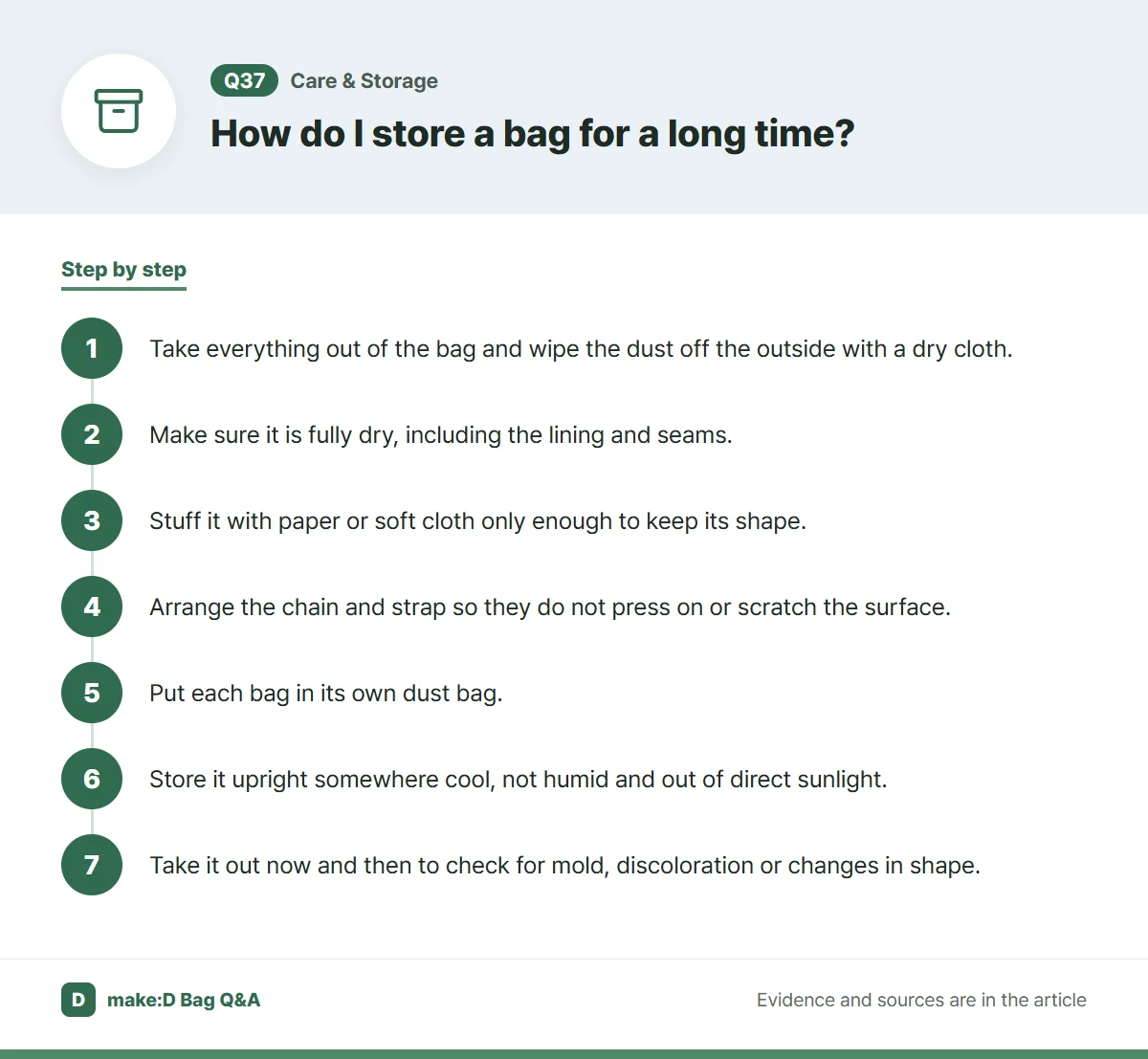
Step by step
- Take everything out of the bag and wipe the dust off the outside with a dry cloth.
- Make sure it is fully dry, including the lining and seams.
- Stuff it with paper or soft cloth only enough to keep its shape.
- Arrange the chain and strap so they do not press on or scratch the surface.
- Put each bag in its own dust bag.
- Store it upright somewhere cool, not humid and out of direct sunlight.
- Take it out now and then to check for mold, discoloration or changes in shape.
Frequently asked questions
Can I store a bag in a plastic bag?
With airtight packaging such as plastic, any moisture left inside cannot escape, which can raise the risk of mold. The usual choice is a breathable fabric dust bag, like the dust cover CCI recommends. In humid seasons, opening the cabinet door now and then to air it out also helps.
What can I use if I have lost the dust bag?
A clean, breathable cotton cloth or pouch can stand in. It is better to avoid dark cloth, since its color may transfer to a light-colored bag. Ask the official store's customer service whether a make:D dust bag can be obtained separately.
What should I do if a bag smells after long storage?
First, take it out and leave it in a well-ventilated, shaded spot to let the moisture escape. Spraying scented products or cleaners on it right away can leave stains, so avoid that, and if you see signs of mold, we recommend asking customer service about its condition. If the smell does not go away easily, also check whether the storage place is too humid.